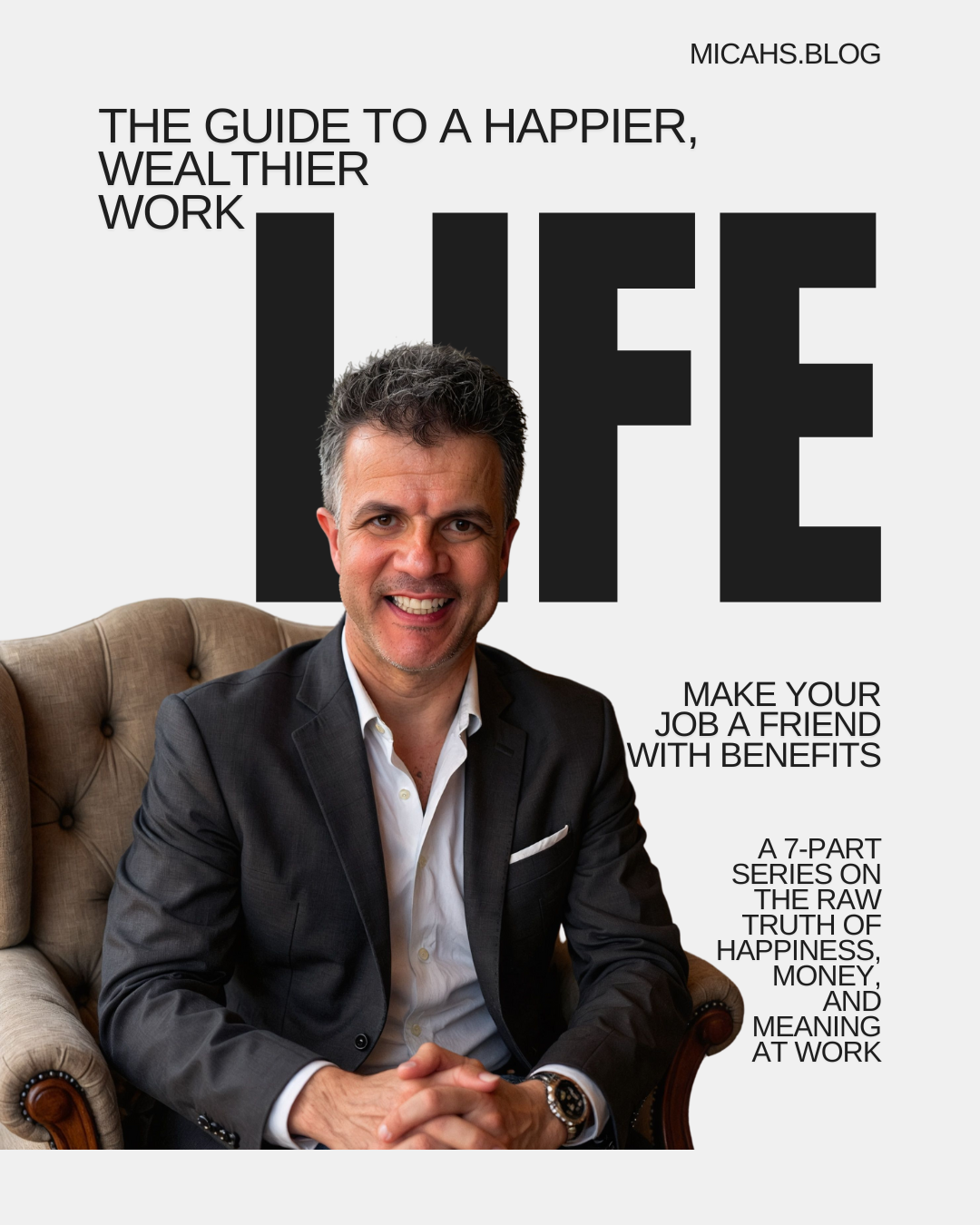
Day #1: Is Your Job Emotionally Unavailable?
If you’ve been with me, you know this: I love my teams. I quietly adore them – actually…. My corporate role is incredible. My nonprofit keeps me mission-driven. And I start this series with a full heart.
Not bitterness. Not burnout. Gratitude.
For the past 10 years, I’ve been lucky enough to choose where I work—and with whom.
Before that, I had the honor of serving under three U.S. Presidents through three administrations.
I’ve seen the highest-pressure rooms. I’ve lived the bottom and built back up.
And I say this with no irony:
I’m a happy person.
Maybe it’s genetic. Maybe it’s my mother.
Or maybe I just suffer from too much happiness.
But that’s exactly why I need to talk about this.
Because this series?
It’s not just about loving your job.
It’s about loving yourself.
It’s about naming what hurts.
It’s about choosing not to suffer silently.
And if you’ve ever worked with me—my teams will tell you—I believe in creating the wave that topples the suffering.
We are the wind.
We’re the soul that drives innovation.
The human who drives the humanoids.
The emotion-filled leader who moves forward with a human matters mentality.
That’s what this series is about.
Now let’s talk about the relationship you’re in—with your job.
It’s Not Just Burnout. It’s Emotional Starvation.
We love to talk about burnout like it’s a time management issue.
“Prioritize better.”
“Take a walk.”
“Do some breathwork between Zoom calls.”
But this isn’t about your calendar.
It’s about your connection—or the lack of it.
This is what psychologists call emotional labor without return.
You invest.
You care.
You stretch.
And the system?
It gives you metrics. Silence. Or another “quick task” that eats your evening.
You don’t need better tools. You need better reciprocity.
What Emotional Unavailability at Work Looks Like
Let’s name it clearly:
- You deliver work—no one acknowledges it.
- You speak up—nothing changes.
- You outperform—and still feel replaceable.
- You’re on every radar when something breaks, but invisible when it works.
- Your input is taken—but rarely credited.
It’s not just disheartening. It’s dehumanizing.
And over time, it breaks something quietly powerful:
Your belief that effort leads to meaning.
The Data Says What You’re Feeling
And this isn’t just your story. It’s systemic.
- 85% of global workers are not engaged or are actively disengaged. (Gallup, 2023)
- 69% say they’d work harder if they felt more appreciated. (Appreciation at Work, 2022)
- Only 30% say they find real meaning in their job. (McKinsey, 2021)
- Employees who feel heard are 4.6x more likely to perform at their best. (Salesforce, 2023)
If you feel under-recognized, under-connected, and over-extended—you’re not broken.
You’re just living in a system that doesn’t reward humanity.
Here’s What You Can Actually Do About It
This isn’t a call to walk away from your job.
It’s a call to renegotiate the terms of engagement.
If you’re an employee, a manager, or an exec—the relationship can shift.
But only if you stop waiting for someone else to start.
Here’s how:
1. Run an Emotional ROI Check (Weekly)
Ask yourself:
- What did I give this job this week—time, ideas, attention, flexibility?
- What did I receive—growth, feedback, care, clarity?
If the answer is “not much” too often, you’re in a one-sided relationship. And that relationship needs boundaries—or a rebuild.
2. Give Feedback a Job—Then Deploy It
Don’t just “encourage feedback.”
Make it do something.
Try:
- “What’s one thing you wish I acknowledged more?”
- “What kind of support feels most helpful from me right now?”
Then model it back—consistently, visibly, without waiting for performance reviews.
3. Set Non-Negotiable Boundaries That Reflect Your Value
Start small, then commit:
- Set communication cutoff times—and honor them.
- Block 2 hours/week for undisturbed focus.
- Say “I’m at capacity” without apology when you are.
These aren’t luxuries. They’re human guardrails.
4. Redefine Productivity Beyond Presence
You are not more valuable because you’re constantly available.
You’re more valuable when you create outcomes, shape culture, and show up with energy.
Stop measuring contribution by how many hours you bleed into your inbox.
5. Ask Bigger Culture Questions (And Listen to the Answers)
If you’re in a leadership seat, ask:
- Do people feel emotionally safe to say “I’m not okay”?
- Do we reward honesty—or just harmony?
- Are we building jobs for humans—or just functions?
If the answers are unclear, it’s time to redesign more than your org chart.
What This Is Really About
Work is a relationship.
One you’re allowed to reimagine.
One you’re allowed to outgrow.
One you’re allowed to demand more from.
This isn’t about being idealistic.
It’s about being human.
Tomorrow: The Money Conversation
Because fulfillment matters—but so does your paycheck.
And if it’s “not about the money,” why are so many people staying stuck in jobs that don’t pay them what they’re worth?
Let’s stop dodging the question.
Okay. That’s a lot to take in. So one more before I let you go…
If your job were a relationship, what boundary would you set that you’ve been too afraid to?
See you at the top!
XO
MV
Sources & Research:
- Gallup, “State of the Global Workplace Report,” 2023
- McKinsey & Company, “The Search for Purpose at Work,” 2021
- Salesforce, Workplace Empowerment Study, 2023
- Appreciation at Work Research, 2022
- Siegrist, J. (2002). “Effort-reward imbalance at work and health.” Occupational Medicine Journal





Leave a Reply