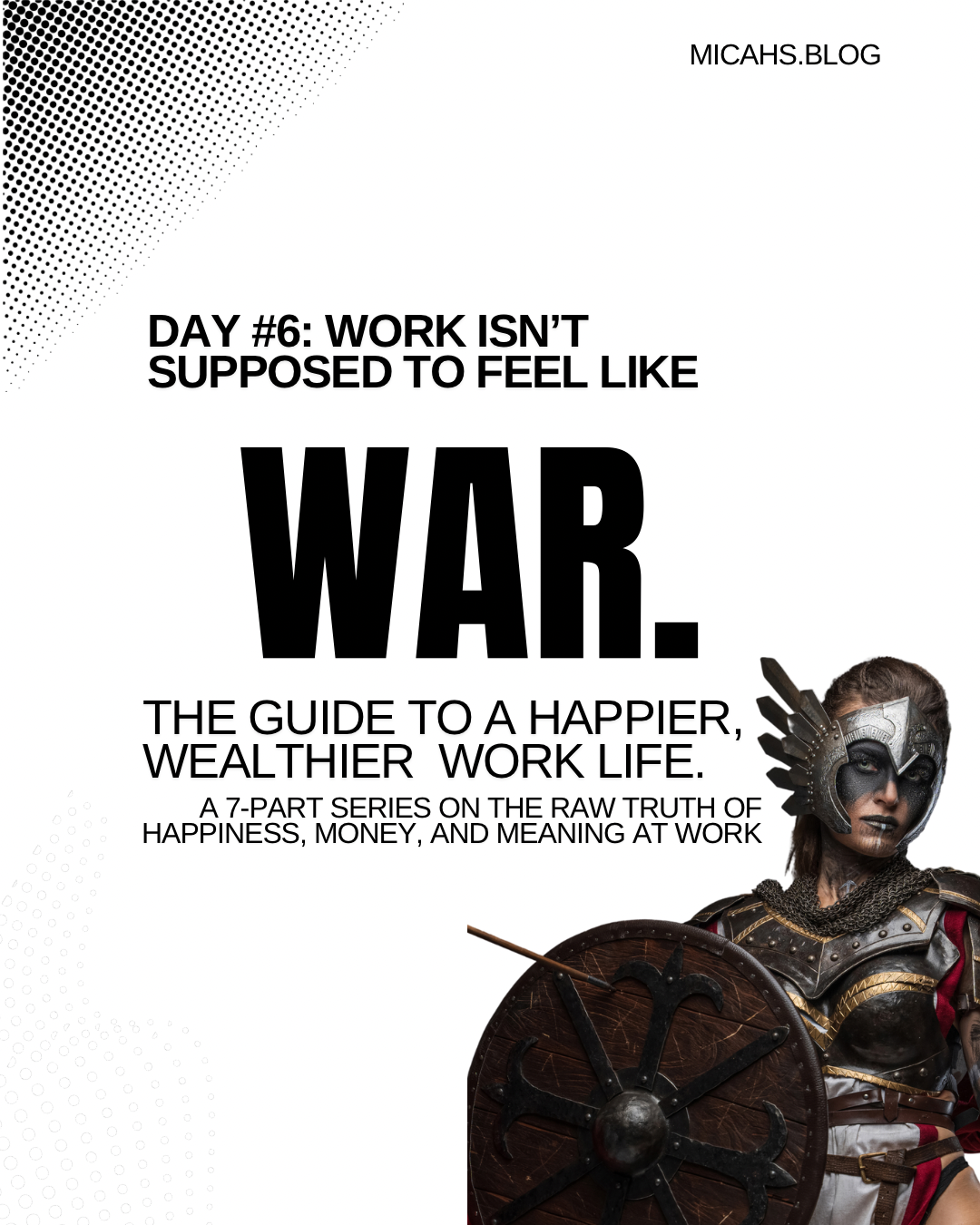
The Guide to a Happier, Wealthier Work Life
Make Your Job a Friend With Benefits
We turned the corner this week and covered some ground that I didn’t think we would—but we did.
You made me think and rekindle thoughts that were buried in the memory graveyard. Nevertheless, it was worth every “i” and “t” dotted and crossed. Thank you.
We left happiness (which was yesterday—be sure to go check it out) and today we turn to something different: combative work environments.
This was one of those topics I could write all night long and still have thoughts to share, so it was hard for me to condense them. But I think I did it—and if not, apologies.
I come from a place of seeing politics—the real one—White House style—to the boiler room—to union contracts—and everything in between.
I’ve been there. Done that.
I’ve been fortunate to have had amazing jobs for the last 10 years or so—including where I am today. I adore—heavy word, but true—the people, the teams, the coworkers.
But as I sat to write this piece, many wounds were sliced open from decades ago.
If you are there now, read on, friend.
There is a plan.
Some days, work feels less like a job—and more like a battlefield.
The meetings are landmines.
The emails are grenades.
The politics are thick enough to choke on.
And surviving the week?
Feels like winning a war you never signed up for.
But here’s the thing no one tells you loud enough:
Work isn’t supposed to feel like war.
Yes, it’s supposed to stretch you.
Challenge you.
Grow you.
But it should never break you.
It should never strip your dignity.
It should never turn you into someone you don’t even recognize at the end of the day.
And if it does?
It’s time to stop calling it “just the way it is.”
The 3 Kinds of Work Cultures
After 20+ years of leading teams, building operations, and living inside every kind of workplace imaginable—
I can tell you almost every environment falls into one of three categories:
1. Combat Culture
• Survival mode is the default.
• Fear is the language.
• Trust is dead before it ever gets a chance.
People don’t speak to collaborate.
They speak to defend.
You don’t just do your job.
You defend your territory.
You protect your back.
You spend more time surviving than thriving.
2. Coasting Culture
• Nobody’s fighting—but nobody’s building either.
• Passion has been quietly buried.
• Meetings are hollow. Smiles are thinner.
It’s safer than war, sure.
But it’s dead inside.
The motto here is:
“Keep your head down. Don’t stir the pot. Just make it to Friday.”
3. Building Culture
• Energy is real.
• Growth is felt.
• People own the mission and own their space.
Here, disagreement isn’t a fight.
It’s collaboration.
Winning isn’t beating each other.
It’s building something together.
You leave tired—but it’s a good tired.
The kind of tired that reminds you you’re alive, not just employed.
Which One Are You Breathing In Every Day?
Because culture isn’t just “out there.”
You breathe it.
You carry it.
You start to mirror it—unless you name it and choose something better.
What You Can Actually Do About It
You might not be able to overhaul the whole company tomorrow.
But you can build your peace inside the chaos.
Here’s where to start:
1. Name What’s Really Happening
Stop gaslighting yourself.
If it feels toxic, it probably is.
If it feels dead, it probably is.
Truth first.
Solutions second.
2. Protect Your Mental Space Daily
Set micro-boundaries:
• Block time for focused work.
• Silence your phone during deep projects.
• Walk outside before you spiral inside.
Your brain isn’t built for non-stop battle.
It needs breathing room to stay sharp and sane.
3. Build Allies, Not Armies
Find the people who:
• Celebrate your wins without jealousy.
• Challenge your ideas without cruelty.
• Cover your back without expectation.
You don’t need a fortress.
You need a tribe.
4. Document Wins and Progress
In war zones, it’s easy to forget what you’re fighting for.
Every week, document:
• What you built.
• What you improved.
• Who you lifted.
Because momentum matters.
Especially when the environment is trying to drain it out of you.
5. Start Building Micro-Cultures
You don’t need an executive title to shift a room.
In every team, every project, every meeting—
you can lead with:
• Humanity.
• Trust.
• Ownership.
• Respect.
Micro-cultures become macro-cultures over time.
You’re planting seeds every time you show up differently.
Let’s End With This
As I said in the beginning, this was tough to write and tough to relive some of the pain of 10++ years ago.
While far from perfect, it’s at least a blueprint of sorts that you can take, change, tweak—or build your own.
It does not matter to me.
What matters to me is that you feel empowered to change.
See you at the top.
Keep climbing—the view is awesome from up here.
Talk soon,
MV
Tomorrow: The Exit Plan
Because sometimes the strongest move isn’t to stay and “fix it.”
Sometimes the strongest move is knowing when to leave—and how to do it powerfully.
Get ready.




Leave a Reply