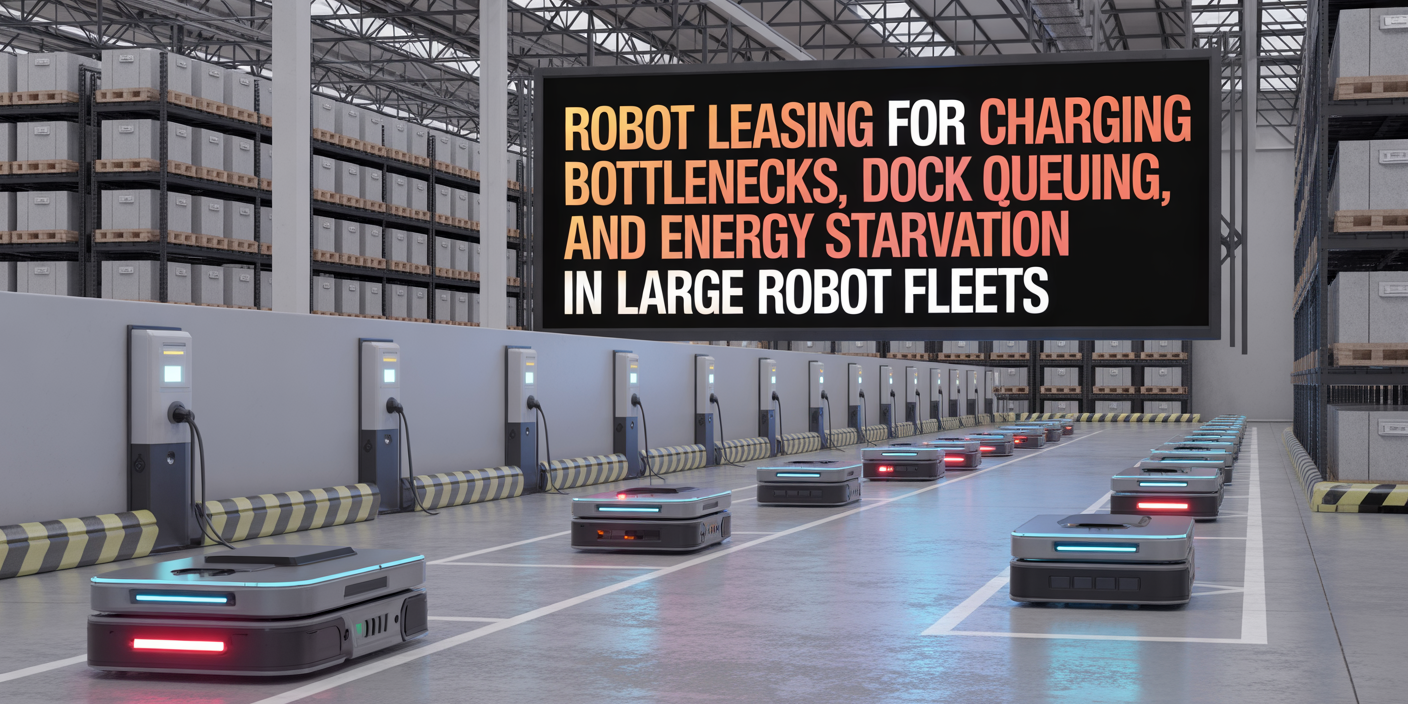
Robot Leasing • Charging • Energy • Fleet Scale • 2026
Robot Leasing for Charging Bottlenecks, Dock Queuing, and Energy Starvation in Large Robot Fleets in 2026
Fleets don’t stop when batteries die.
They slow long before that.
Charging capacity, not robot count, often determines real throughput.
How Charging Bottlenecks Show Up in Operations
- ■ robots queue instead of executing tasks
- ■ low-battery avoidance reduces task acceptance
- ■ peak windows collide with charging cycles
- ■ utilization metrics hide idle time
- ■ teams add robots instead of docks
Energy friction looks like efficiency loss, not failure.
The Four Energy-Driven Cost Multipliers
1. Dock Queuing
Robots wait while work piles up.
2. Energy Starvation
Tasks are deferred to protect charge.
3. Fleet Inflation
Extra robots mask energy limits.
4. SLA Distortion
Uptime stays high while output drops.
Batteries define cadence.
Executive Questions That Expose Charging Risk
- ■ How many robots share each dock?
- ■ When do charging peaks occur?
- ■ Are fast chargers creating local congestion?
- ■ Is energy usage logged per task?
- ■ Who owns charging expansion decisions?
If energy isn’t planned, capacity is imaginary.
Engineering Patterns for Scalable Charging
- ■ distributed charging zones
- ■ staggered charging policies
- ■ energy-aware task assignment
- ■ charging metrics tied to throughput
- ■ dock capacity modeled before fleet growth
Charging is part of flow design.
Lease vs Buy Under Energy Constraints
Leasing Wins When
- ■ fleet size may grow
- ■ charging behavior is unproven
- ■ infrastructure will evolve
- ■ energy risk must be shared
Buying Wins When
- ■ charging is overprovisioned
- ■ energy metrics are stable
- ■ expansion is governed
- ■ cadence is predictable
Leasing buys learning time. Ownership works once energy is engineered.
Your 1–2–3 Path for Energy-Aware Decisions
-
1 — Robot Integration Readiness Score
Assess charging maturity and energy governance.
→ Take the Readiness Score -
2 — Robot ROI Calculator
Model idle time, dock queues, and fleet inflation.
→ Run the ROI Calculator -
3 — Lease vs Buy Robots Calculator
Compare models once charging is treated as capacity, not background.
→ Use the Lease vs Buy Calculator
Energy governs motion. Leaders who design for charging protect throughput, ROI, and credibility in 2026.
Leasing de Robôs • Carregamento • Energia • Frotas • 2026
Leasing de Robôs e Gargalos de Carregamento em Grandes Frotas em 2026
Robô parado não está quebrado.
Está esperando energia.
Capacidade de carregamento define produtividade real.
Como gargalos aparecem na operação
- ■ filas nos docks
- ■ tarefas adiadas por bateria
- ■ picos colidem com carregamento
- ■ frota cresce sem ganho real
- ■ ROI distorcido
Energia limita escala.
Leasing ou compra sob restrição energética?
Quando leasing faz mais sentido
- ■ frota ainda cresce
- ■ carregamento não foi validado
- ■ infraestrutura muda
- ■ risco precisa ser dividido
Quando comprar pode ser melhor
- ■ carregamento é abundante
- ■ métricas são estáveis
- ■ expansão é governada
- ■ ritmo é previsível
Leasing compra aprendizado. Compra funciona quando energia vira engenharia.
Seu caminho 1–2–3 para decidir
-
1 — Robot Integration Readiness Score
Avalie maturidade energética.
→ Calcular o Readiness Score -
2 — Robot ROI Calculator
Modele filas e ociosidade.
→ Rodar o ROI Calculator -
3 — Lease vs Buy Robots Calculator
Compare modelos com energia explícita.
→ Comparar no Lease vs Buy Calculator
Energia é parte do sistema. Quem respeita isso protege ROI em 2026.





Leave a Reply