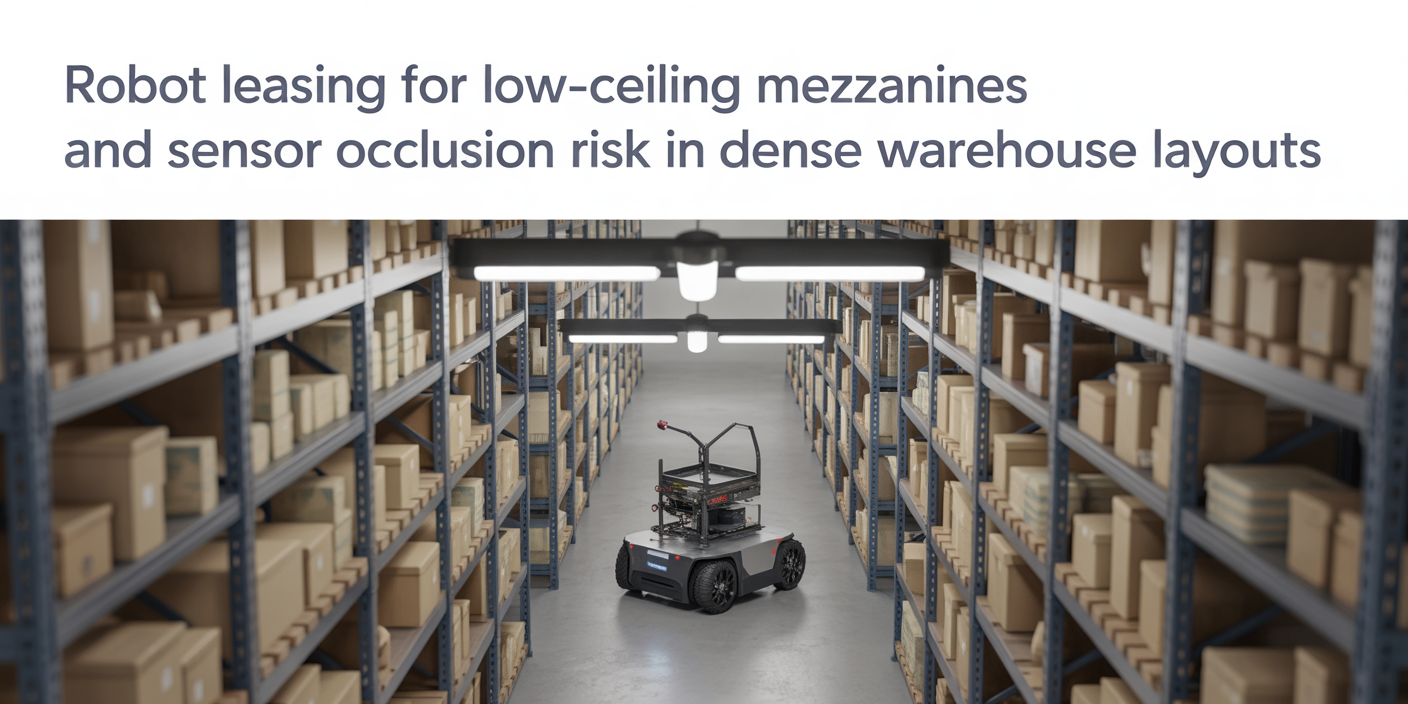
Robot Leasing • Low Ceilings • Mezzanines • Dense Layouts • 2026
Robot Leasing for Low-Ceiling Mezzanines and Sensor Occlusion Risk in Dense Warehouse Layouts in 2026
Most automation plans obsess over floor space.
Low ceilings are treated as background architecture.
In reality, ceiling height defines sensor visibility, safety envelopes, and how often robots hesitate, slow down, or stop.
How Low Ceilings Change Robot Behavior
- ■ overhead beams and mezzanines occlude lidar fields
- ■ lighting fixtures generate reflections and false positives
- ■ safety zones compress vertically and horizontally
- ■ robots slow down to preserve clearance confidence
- ■ emergency stops increase in cluttered overhead areas
Robots see the world in volumes, not floor plans.
The Four Layout-Driven Cost Multipliers
1. Sensor Blind Spots
Overhead obstructions block or distort perception, forcing conservative navigation logic.
2. Safety Envelope Inflation
Tighter clearances expand virtual safety buffers, reducing throughput.
3. Commissioning Drag
Mapping and tuning take longer in dense vertical environments.
4. Hidden Downtime
Intermittent stops under mezzanines erode uptime without triggering alarms.
Low ceilings rarely break robots — they quietly slow the business case.
Executive Questions That Expose Ceiling Risk
- ■ What is the lowest clearance along every robot route?
- ■ Where do mezzanines overlap with high-traffic paths?
- ■ Have vendors tested this ceiling profile before?
- ■ Are lighting and signage accounted for in mapping?
- ■ Who owns redesign if safety zones shrink throughput?
If ceiling height is not discussed, it will surface later as “performance variance.”
Engineering Patterns for Low-Ceiling Layouts
- ■ sensor stacks tuned for short-range vertical perception
- ■ reduced mast height and compact sensor housings
- ■ lighting standardization under mezzanines
- ■ ceiling-aware mapping and zoning
- ■ physical clearance audits before go-live
Ceiling constraints demand design discipline, not optimism.
Lease vs Buy Under Low-Ceiling Constraints
Leasing Wins When
- ■ ceiling profiles vary across zones
- ■ mezzanines may be reconfigured
- ■ sensor performance is unproven in tight spaces
- ■ you want layout risk shared with the vendor
Buying Wins When
- ■ clearances are stable and documented
- ■ robots are proven in similar facilities
- ■ throughput impact is well modeled
- ■ in-house teams own mapping and tuning
Leasing protects you while ceiling behavior is learned. Ownership works once vertical constraints are predictable and engineered.
Your 1–2–3 Path for Ceiling-Aware Decisions
-
1 — Robot Integration Readiness Score
Assess ceiling height variability, mezzanine density, and layout discipline before committing to hardware.
→ Take the Readiness Score -
2 — Robot ROI Calculator
Model throughput loss, tuning time, and downtime tied to low-clearance navigation.
→ Run the ROI Calculator -
3 — Lease vs Buy Robots Calculator
Compare leasing and buying once layout-driven risk is quantified, not assumed away.
→ Use the Lease vs Buy Calculator
Ceiling height is not architecture — it is a control surface. Leaders who treat vertical constraints as a first-class variable protect uptime, trust, and ROI in 2026.
Leasing de Robôs • Pé-direito Baixo • Mezaninos • Layout Denso • 2026
Leasing de Robôs em Mezaninos com Pé-direito Baixo e Risco de Oclusão de Sensores em 2026
Planos de automação costumam focar no chão.
O pé-direito vira detalhe arquitetônico.
Na prática, a altura do teto define visibilidade de sensores, zonas de segurança e ritmo operacional.
Como tetos baixos afetam o robô
- ■ vigas e mezaninos bloqueiam campo de visão do lidar
- ■ luminárias geram reflexos e leituras falsas
- ■ zonas de segurança ficam mais restritivas
- ■ robôs reduzem velocidade para manter confiança
- ■ paradas inesperadas aumentam sob estruturas
Robôs enxergam volumes, não plantas baixas.
Quatro multiplicadores de custo do layout vertical
1. Pontos cegos de sensor
Obstáculos acima distorcem percepção e navegação.
2. Zonas de segurança ampliadas
Menos espaço significa mais cautela e menos fluxo.
3. Atraso na comissionamento
Mapeamento em ambientes densos leva mais tempo.
4. Downtime invisível
Pequenas paradas recorrentes corroem o ROI.
Pé-direito baixo não quebra o robô — quebra a previsibilidade.
Perguntas executivas sobre risco de teto baixo
- ■ Qual é a menor altura em todas as rotas?
- ■ Onde mezaninos cruzam áreas críticas?
- ■ O fornecedor já operou nesse cenário?
- ■ Iluminação foi considerada no mapeamento?
- ■ Quem responde se o fluxo cair?
Se o teto não entra na conversa, entra na conta depois.
Leasing ou compra sob restrições de teto?
Quando leasing faz mais sentido
- ■ alturas variam entre zonas
- ■ layout pode mudar
- ■ comportamento do sensor ainda é incerto
- ■ você quer dividir risco com o fornecedor
Quando comprar pode ser melhor
- ■ pé-direito é estável e documentado
- ■ robô já provou desempenho similar
- ■ impacto no fluxo é conhecido
- ■ time interno domina mapeamento
Leasing protege enquanto você aprende o comportamento vertical. Compra funciona quando o risco já foi domado.
Seu caminho 1–2–3 para decidir
-
1 — Robot Integration Readiness Score
Avalie variabilidade de teto e densidade de mezaninos antes de travar hardware.
→ Calcular o Readiness Score -
2 — Robot ROI Calculator
Modele perda de fluxo e tempo extra de ajuste ligados ao layout vertical.
→ Rodar o ROI Calculator -
3 — Lease vs Buy Robots Calculator
Compare leasing e compra com risco de layout incorporado ao modelo.
→ Comparar no Lease vs Buy Calculator
Altura de teto é variável de projeto. Líderes que tratam o espaço vertical com disciplina protegem ROI e credibilidade em 2026.




Leave a Reply